

In 2003, after graduating from college as a corporate engineer, I had my sights set on working in purchasing, but the job market wasn't great, and I ended up at E.ON Elnät in Nässjö by chance. There, I met some fantastic people who had been in the industry for at least 20 years and took enormous pride in their work.
Above all, I was fortunate to work with Margareta and Birgitta, who were passionate about order and tidiness and putting the right things in the right place. That's where my interest in documents and document management was sparked, and when storm Gudrun ravaged the country in 2005, I really got to experience the importance of effective document management.
In this and future posts, I will provide an overview of what document management has been historically, how it has changed and been managed over time, and what our experiences are in this area.
Let's start with a brief historical review.
Document management in the past
To understand how document management has changed and been handled over time, we begin sometime in the 1980s, in modern times and at the very beginning of the great computerization. Sven Ferdinandsson, founder of SQL Systems, started his first job at Sydkraft by rebuilding the hydroelectric power stations in Knäred. PLC systems, programmable control systems, were to be introduced, and when he and his colleagues arrived, the electrical documentation consisted of a single drawing, drawn in ink on waxed linen cloth and measuring approximately 1*2 m. The electrical installation consisted mainly of a large panel with marble slabs, where most of the electrical equipment had been installed. When the renovation was complete, they left behind 5-6 binders of documentation, three beautiful ASEA gray cabinets, and a PLC system from SATT.
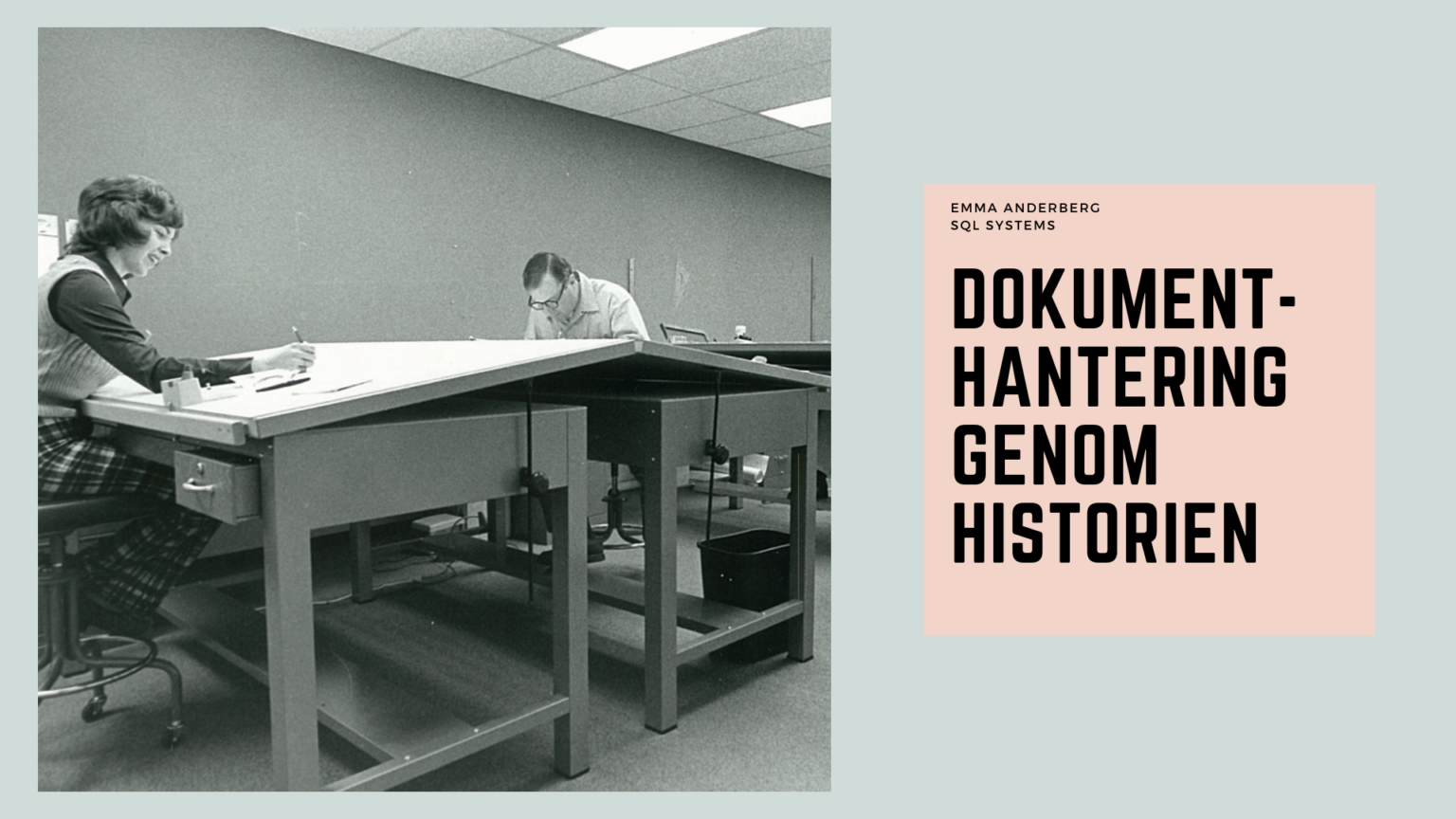
At that time, it was not unusual for companies to have a documentation department that handled documents. It was often women who drew on film with ink, and the only way to make changes was to scrape off the ink with a razor blade; it was a craft. These departments ensured that the documentation was up to date, and when someone in the business needed a drawing, the documentation department made sure to produce what was requested. With the advent of computerization and a desire to streamline and save money, more and more companies chose to phase out their documentation departments.
As company management, it has been easy to deprioritize documentation management, probably because it has been assumed that this work is now done digitally and can therefore be easily handled by the rest of the organization.
But then you haven't considered that those 5-6 binders that Sven and his colleagues left behind when they finished the renovation in Knäred have also multiplied many times over as a result of digitization.
How has document management been affected by digitization?
Let's return to the Knäred Övre power station, which was built in 1912 and, with its renovation in the early 1980s, went from Industry 2.0 to 3.0. We can assume that the updated documentation existed in a couple of editions, one at the power station and one at the central archive in Malmö. No documentation was yet available in digital form, but this would soon change.
Responsibility for documentation changed
Over the following decades, the pace of digitization increased, as did the centralization of companies and their assets. With the trend toward larger organizations, the departments responsible for documentation disappeared. Instead, responsibility was spread throughout the organization with the idea that each person would take care of "their" documentation.
So, as the digitization of society increased and created more documents, document management became less and less important in the new, larger organizations. Document management was increasingly seen as merely a cost that was "easy" to change, and management has had difficulty understanding the importance of well-managed document management.
The number of documents increased
To explain how digitization has affected the volume of documents, we will once again draw on Sven's experiences.
Ten years ago, few organizations understood how incredibly important technical document management would become. When people talk about AI, the Internet of Things, and Industry 4.0 today, they often forget that if you don't have value-adding document management, you still have a long way to go before you have a functioning AI.
In part 2 of our journey through document management, we will take a closer look at how things stand today. Until then, feel free to ponder the question, "What is a document?"
If you have any questions about document management or would like to get in touch with me, please send an email to Emma@sqlsystems.se. Follow us on LinkedIn to stay up to date!